
AI, The Hallucinating Chemist
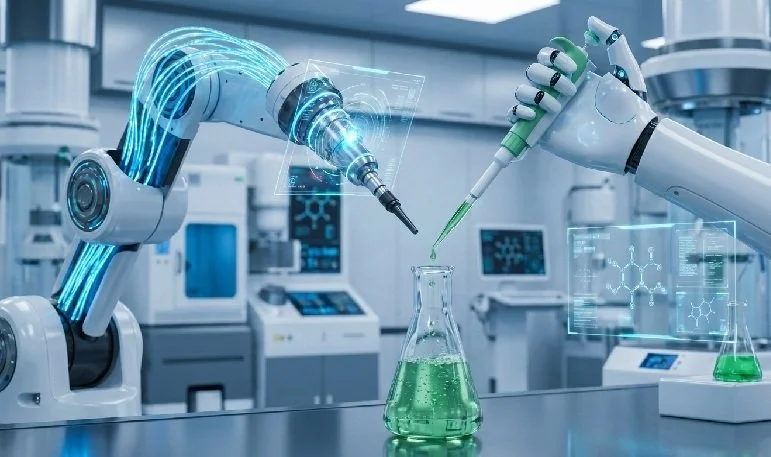
AI tools are confident, fast, and often completely wrong. Here is why "hallucinated" chemical data is the new safety risk in your lab, and why human verification is the only fix.
If you ask a Generative AI tool to design a synthesis route for a novel compound today, it will give you a confident answer. It will list reagents, outline reaction conditions, and even cite academic papers to back it up.
It looks like a miracle of efficiency. But in the lab, that confidence is dangerous.
As EHS and compliance professionals, we are watching a dangerous trend unfold. Researchers are treating Large Language Models (LLMs) like verified databases. They aren't. They are predictive text engines, "autocorrect" on steroids. They don't know chemistry; they just know which words usually follow each other in a sentence.
In creative writing, making things up is a feature. In chemical safety, it’s a liability.
The hazard of AI hallucinations in Chemistry
The danger isn't that AI gives you gibberish. If it did, we would ignore it. The danger is that AI can give you plausible, authoritative-sounding nonsense. This is called "hallucination," and it happens frequently when you ask for specific technical data.
We are seeing AI tools:
Invent CAS numbers: Generating 9-digit codes that look real but don't exist in any inventory.
Fabricate references: Citing papers from real journals with real authors, but with titles that were never written.
Misinterpret scale: Suggesting a bench-top procedure that, if you tried it in a 500-gallon reactor, would cause a thermal runaway.
Case study: The "Flash Point" prediction risk
A junior researcher asks AI for the flash point of a specific solvent mixture to fill out a waste label.
The AI doesn't "look up" the data, it predicts it. It might use data from two similar solvents and confidently tell the researcher the flash point is 150°C. In reality, it’s 45°C.
The researcher trusts the tool, labels the drum as "Non-Flammable," and stores it next to a heat source. The result isn't a typo on a form; it’s a potential fire in your waste storage area.
Missing the engineering context
AI is trained on literature, much of which happens in controlled environments. It lacks the engineering context of your facility.
An AI might suggest a solvent swap to optimize a reaction, failing to realize that the new solvent eats through the specific gaskets on your transfer lines. It sees the chemical compatibility; it misses the engineering integrity.
The creativity paradox: When "wrong" is useful
It is important to note that many scientists actually view AI hallucinations as a benefit, not a bug. In the early stages of R&D, an AI that "dreams" up a non-existent reaction pathway can act like a digital prompt for human creativity, breaking rigid thinking patterns.
But this is exactly why the machine cannot take over.
AI lacks the self-awareness to know when it is being creative (inventing a novel idea) and when it is being deceptive (inventing a fake safety limit).
For discovery: The hallucination is a spark.
For compliance: The hallucination is a hazard.
This distinction is the ultimate barrier to full automation. The AI provides the chaos of possibility; the human Safety Officer provides the order of reality. As long as AI cannot distinguish between a brilliant new hypothesis and a dangerous lie, the human gatekeeper is irreplaceable.
Trust, but verify
This isn't a call to ban AI from the lab, that’s impossible. It is a call to return to the scientific method: verification.
We need to stop viewing AI as an "expert" and start viewing it as an "intern." It can gather data for you, but you should never sign off on its work without checking it first.
The new rule for your team
Check the CAS: Never trust a number generated by AI without cross-referencing the TSCA inventory or ECHA database.
Click the link: If it cites a paper, find the Digital Object Identifier (DOI). If you can't read the abstract, the paper probably doesn't exist.
Context is important: AI knows generalities. You know your facility.
The bottom line
AI can write your emails, and it can draft your summaries. But it cannot sign off on your Risk Assessment. In an era of automated information, the most valuable asset in your lab isn't the data itself, it’s the human experience required to question it.
The Valence Regulatory Technical Team Your partners in chemical safety.