
OSHA Citation 1910.1200
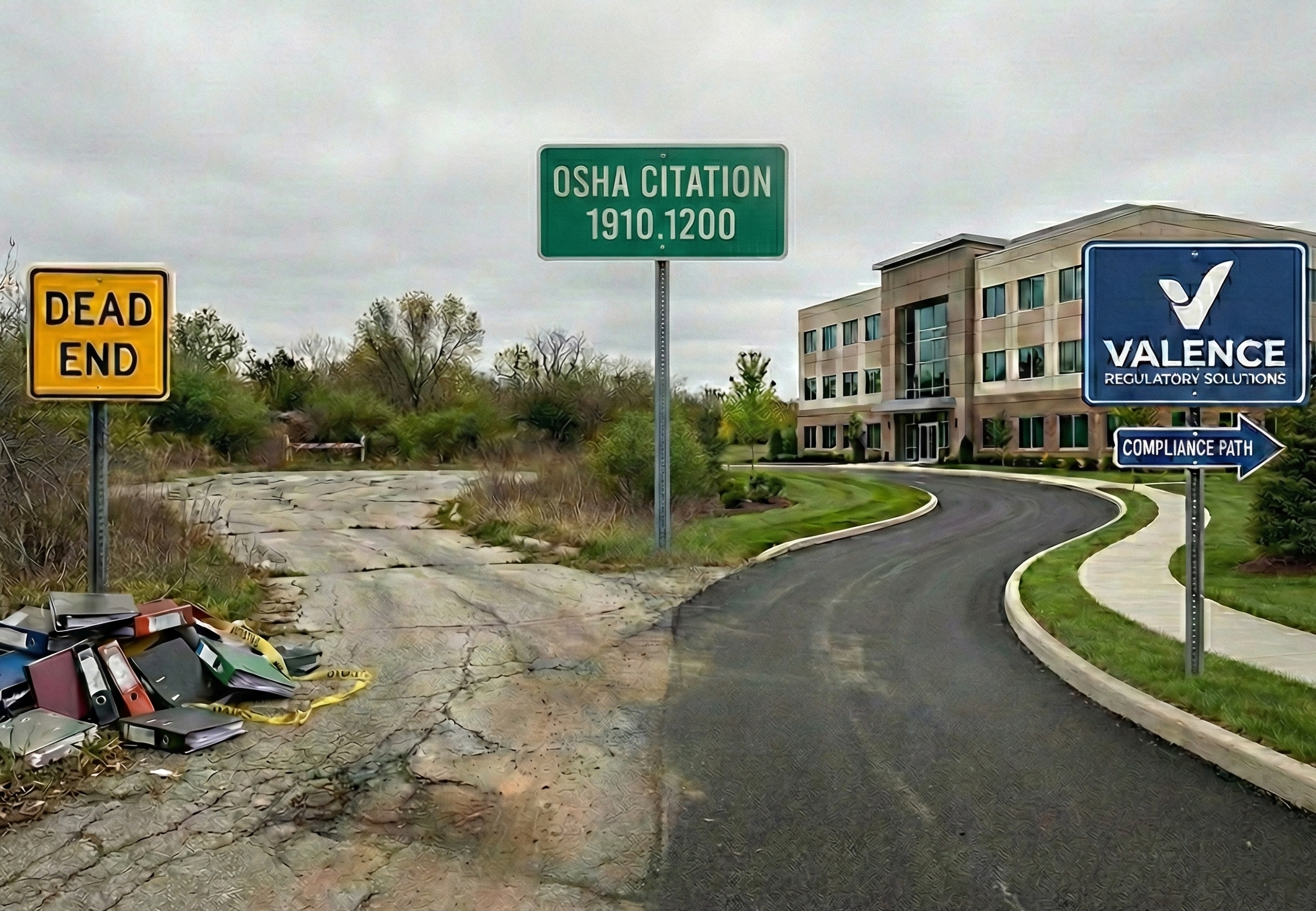
How to Avoid (and Survive) OSHA Citation 1910.1200
1910.1200 is the #2 most cited standard during OSHA’s inspections. Here is what inspectors look for, your defense strategy and how CPL 02-00-163 gives you a 15-day window to save your bottom line.
When an OSHA inspector walks into a facility, they don't always start with the complex machinery or the air quality sensors. They often start with the easiest thing to check: the binder.
For years, Hazard Communication (29 CFR 1910.1200) has remained the #2 most cited standard in the United States. Why? Because it is purely administrative. An inspector can spot a violation in five minutes just by asking for a document you don't have.
If you are relying on a dusty binder of SDSs to keep you safe, you are missing the other two-thirds of the law. Here are the three most common citation categories we see at Valence Regulatory, and how to use OSHA’s own "Chapter 7" protocols to defend yourself.
1. Violation of 1910.1200(e)(1): Written Program Requirements
Most employers have Safety Data Sheets (SDSs). But many fail to have the required administrative document that explains how they manage them.
The Citation: “Employers shall develop, implement, and maintain a written hazard communication program...”
You have the chemicals, but you lack the site-specific document detailing who labels containers, how non-routine tasks are handled, and how contractors are informed of hazards. In this case, a generic template is not sufficient. You need a Written Hazard Communication Program tailored to your specific chemical inventory, it must reflect your actual facility operations and not a hypothetical one.
2. Violation of 1910.1200(h)(1): Employee Information and Training
You trained your employees during onboarding but, can they answer the inspector's questions today?
The Citation: “Employees were not provided effective information and training on hazardous chemicals...”
If an inspector asks an employee "What are the hazards of this solvent?" and they cannot answer, you are liable. It does not matter if they signed a roster years ago, if they cannot demonstrate the knowledge now, the training was not effective.
You need to implement a targeted training, using focused modules that address the specific chemicals in their work area and maintain audit-ready signed rosters.
3. Violation of 1910.1200(g)(1, 8): Maintenance of Safety Data Sheets (SDSs)
This is the most frequent violation within the standard.
The Citation: “The employer shall maintain in the workplace copies of the required safety data sheets...”
If you are missing an SDS for a specific chemical, or the existing SDS is not compliant with OSHA HCS, you are liable. Your library must be a living document. Conduct an audit every 6 months to reconcile your purchasing records with your SDS binder.
The "Exit Strategy": The 15-Day Lifeline (CPL 02-00-163)
If you do receive a Citation and Notification of Penalty, you are not out of options, but you are out of time.
According to Chapter 7 of OSHA Directive CPL 02-00-163 ("Post-Citation Procedures"), you have exactly 15 working days to request an Informal Conference with the Area Director.
The Informal Conference is your single best opportunity to negotiate a reduction in penalties or reclassify violations, but only if you bring proof of abatement.
The Area Director has the discretion to reduce fines if you can demonstrate "Good Faith" and rapid correction of the hazard. Walking into that meeting with a completed Abatement Package (Corrected Written Hazcom Program + Training Logs) is the difference between paying full price and negotiating a settlement.
How Valence Regulatory Helps
If you are in that 15-day window, speed is everything. We specialize in rapid Abatement Services for Standard 1910.1200.
We don't just give you advice; we build the artifacts you need to hand to the Area Director:
Site-Specific Written Hazard Communications Programs (compliant with (e)(1)).
Retroactive Training decks & rosters (compliant with (h)(1)).
Gap Analysis of your SDS library.
The Valence Regulatory Technical Team Your partners in chemical safety.