
Chemicals Under Pressure
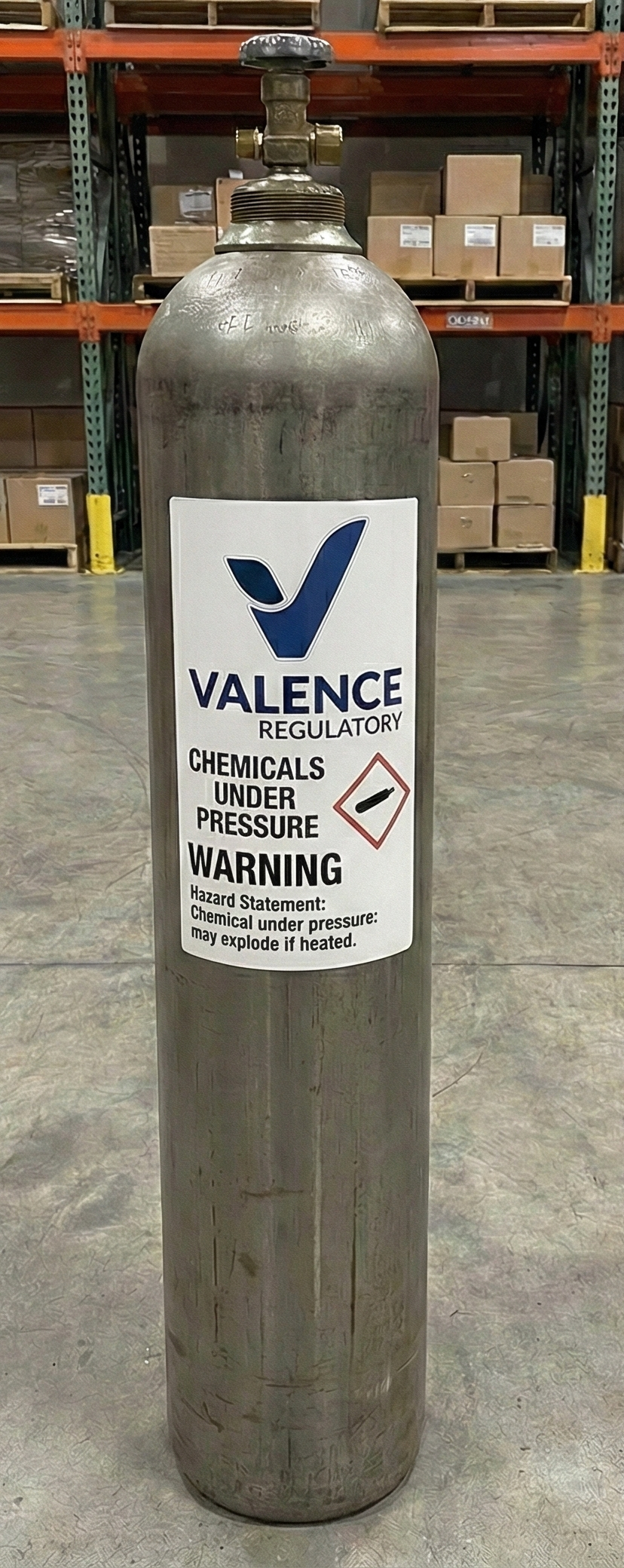
The new "Chemicals Under Pressure" hazard class has created a dangerous regulatory gap between OSHA and WHMIS.
If you sell industrial adhesives, spray foams, or chemical cleaners in cylinders (not standard aerosol cans), check your Safety Data Sheets (SDS) immediately.
As of December 15, 2025, Canada’s grace period for the "Chemicals Under Pressure" hazard class has officially ended. If you are shipping these products to Canada with a standard "Gases Under Pressure" or "Flammable Liquid" label, you are technically non-compliant.
Here is what you need to know about the new regulatory reality for 2026.
1. What is "Chemicals Under Pressure"?
Both OSHA (HCS 2024) and Health Canada (WHMIS 2022 Amendments) have adopted this new hazard class from GHS Revision 7/8. It closes a specific loophole.
In the old way, if you had a cylinder containing 50% liquid glue and 50% compressed gas, you often had to classify it awkwardly as a "Flammable Liquid" and a "Gas Under Pressure." It was confusing for emergency responders.
In the new way, this product is now distinct.
Aerosols: Defined by the specific "aerosol dispenser" mechanism (non-refillable, self-closing valve).
Chemicals Under Pressure: Liquids or solids (pastes, powders) pressurized by a gas in a receptacle (often refillable or larger cylinders) at 200 kPa or more.
2. The Regulatory Gap
This is where US exporters get burned.
In Canada (WHMIS): The law is active now. The transition period ended on Dec 15, 2025. If your Canadian SDS/label doesn't explicitly state "Chemical Under Pressure" (Category 1, 2, or 3), it is wrong.
In the USA (OSHA): The rule is final but delayed. The mandatory compliance deadline for substances is not until May 19, 2026 (extended from Jan 19), and mixtures have until 2027.
The Commercial Risk: US manufacturers are waiting for the OSHA deadline to update their labels. But if you ship that "old" label to a Canadian distributor today, their rigorous intake algorithms may reject it because it fails the WHMIS 2025 check.
3. Who is Affected?
This mostly impacts the "Intermediate Industrial" market—products that aren't quite big tanks, but aren't small spray paint cans either.
Industrial Spray Adhesives (Canisters).
Expanding Foams (Insulation kits).
Pesticide Cylinders.
Fire Suppression Agents.
4. What Should You Do?
You have two options, but only one is smart.
Option A : Keep your "OSHA 2012" labels and hope Canadian customs doesn't notice. (Not recommended).
Option B : Early-adopt the OSHA HCS 2024 standard now.
OSHA allows you to use the new rules immediately.
By updating to "Chemical Under Pressure" today, you satisfy Canada’s mandatory requirement AND future-proof your US compliance for the next 5 years.
Navigating these conflicting timelines between US and Canadian regulations can be complex. If you are unsure how these changes affect your specific product portfolio or need assistance bringing your labels and SDSs into compliance for both markets, contact Valence Regulatory today to discuss your situation.
The Valence Regulatory Technical Team Your partners in chemical safety.